Two men wearing daka topis were chatting leisurely under the eaves of a street corner
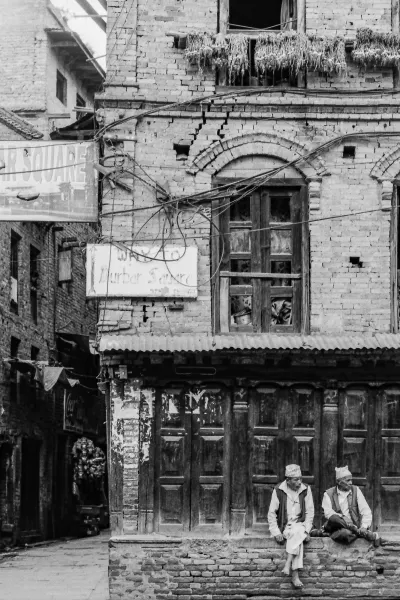
I found myself wandering aimlessly through the labyrinthine streets of Bhaktapur, Nepal's ancient capital. Once the glorious seat of the Malla kings, the city remains deeply steeped in a distinctly medieval atmosphere. It is a place where old edifices of red brick and intricately carved wooden window frames stand cheek by jowl, beneath a sky obscured by a chaotic, haphazard tangle of electrical wires. Deep fissures run along the walls of these buildings, suggesting not so much the dignified weight of history as the perilous fragility of sheer dilapidation. Dangling from the corner of one such crumbling structure was a hand-painted sign that simply read, "WAY TO Durbar Square." It seemed that navigating this dimly lit alley was the designated route to the city’s historic heart.
Just beside the entrance to that very alleyway, two elderly men were perched comfortably on the raised ledge of a storefront. Utterly indifferent to the tourists hurrying past toward the famous landmarks, they had staked their claim to the stoop with an air of absolute ownership. Both were dressed in what could only be described as the classic Nepali uniform: a collared shirt worn under a vest, crowned with a Dhaka topi, the traditional geometric-patterned cap. I had heard that the name "Dhaka" originates from an era when the fabric was imported from the capital of Bangladesh, though today it has seamlessly woven itself into the cultural fabric as the definitive national hat of Nepal.
Curious, I lingered to see what these men, adorned in their deeply rooted national headwear, were actually up to. As it turned out, they were doing absolutely nothing. One man dangled a bare foot, while the other sat cross-legged; they were merely whiling away the hours in idyllic, aimless chatter. The fact that the path unfolding right before their eyes led directly to a globally revered World Heritage site mattered little to them—it was nothing more than the humdrum backdrop of their daily existence. Watching them, it struck me that retreating to a shaded stoop to simply shoot the breeze might just be a far more sensible way for a human being to spend an afternoon than sweating profusely out of a misplaced obligation to marvel at grand palaces and ancient temples.
| Dec 2009 IN THE CITY NEPAL | |
| BHAKTAPUR CAP CHAT DUO EAVE ELECTRIC WIRE MAN OLD TOWN WORLD HERITAGE SITE |
Similar photos


PHOTO DATA
No
3503
Shooting Date
Jun 2009
Posted On
December 18, 2009
Modified On
May 26, 2026
Place
Bhaktapur, Nepal
Genre
Street Photography
Camera
CANON EOS 1V
Lens
EF85MM F1.2L II USM