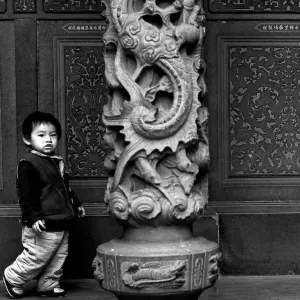
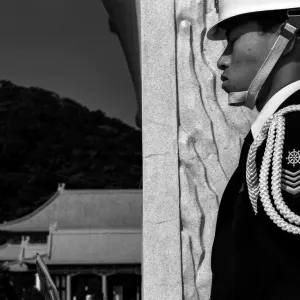
A man was planing in the Minchuan Old Street, which still has an old atmosphere
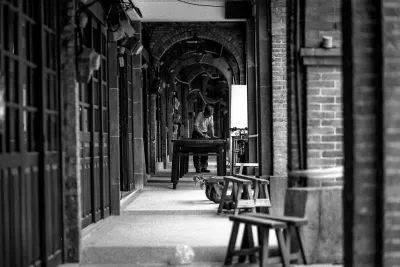
In the Japanese lexicon, there is a rather cruel word: rougai, a derogatory term for an aging generation deemed a burden. Yet, across the sea in the Chinese-speaking world, a slight shift in characters gives us laojie—simply, "old street." It is one of the curious conveniences of a shared writing system that the same visual roots can evoke such profoundly different resonances. Pondering this linguistic divergence, I found myself strolling through the historic district of Sanxia, a town in northern Taiwan.
The streets here are lined with stately red-brick facades, architectural relics surviving from the Taisho era of Japanese colonial rule. If you look closely at their design, you notice the ground floors retreat from the street, creating a continuous, covered arcade known locally as a qilou. It is an eminently practical architectural vernacular designed to shield pedestrians from the sudden, unyielding downpours of the subtropics—a sensible design I have often encountered throughout Southeast Asia.
I drifted aimlessly through the dim, sheltered tunnels of these arcades. The town was in the throes of a sweeping, wholesale renovation, clearly laying the groundwork to rebrand itself as a prime tourist destination. Craftsmen bustled everywhere, busily preparing the historic street for its polished rebirth. Looking down the long colonnade, my eyes caught a solitary figure. A man had dragged a wooden table and some stools out into the walkway. Head bowed, he was completely absorbed in his labor, silently running a hand plane over the wood.
I stood at a distance, idly watching the craftsman at work. Ultimately, I mused, this is the inevitable fate of old streets that have fallen out of step with the modern era: they must apply a fresh coat of cosmetic nostalgia and resurrect themselves as tourist attractions simply to survive. To abandon antiquity as it is would be to invite rot and ruin; to bulldoze it all for sterile, concrete blocks would be entirely devoid of soul. In the end, recycling these aging facades into open-air heritage theme parks—a pragmatic scheme to sweep up the loose change of wandering travelers—is perhaps the soundest and healthiest survival strategy of all.
| Apr 2007 IN THE CITY TAIWAN | |
| BRICK MAN OLD TOWN PASSAGE SANSIA |
Similar photos
PHOTO DATA
No
845
Shooting Date
Jan 2007
Posted On
April 15, 2007
Modified On
May 19, 2026
Place
Sansia, Taiwan
Genre
Street Photography
Camera
CANON EOS 1V