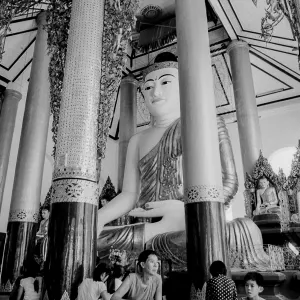
Several Buddha statues were sitting in a hall built in Shwedagon Paya
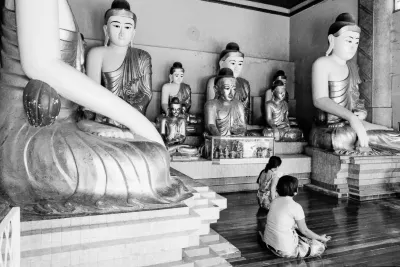
I wiped the sweat from my brow as I wandered through the sprawling grounds of Shwedagon Pagoda, Myanmar’s ultimate spiritual epicentre. Rising high above the hills of Yangon, the colossal golden stupa is flanked by dozens of smaller shrines, clustered around its base like architectural afterthoughts. Peering into these pavilions, I found myself confronted by an army of large Buddha statues, all comfortably ensconced in the shadows. Whether these structures were equivalent to the sub-temples one finds in a grand Japanese monastery, I had absolutely no layman's clue. In fact, distinguishing the true differences between these sanctuaries—or the variations among the myriad Buddhas, from the monumental to the miniature—proved utterly beyond me.
Stepping into one of these indistinguishable shrines, I was greeted by yet another dense assembly of statues jostling for space. On the polished wooden floor, two women sat quietly, immersed in what appeared to be deep meditation. Their gaze was fixed resolutely on a particularly large Buddha positioned at the far right. To my eyes, however, every face in the row possessed the exact same seamless, lacquered smoothness. Aside from their scale, I could discern no defining characteristics whatsoever. Each shared the same uniform, placid expression; each held the same identical posture. Why these women had singled out the statue on the right as the target of their devotion remained a complete mystery to my ordinary mind.
Yet, as I studied these inscrutable figures more closely, a pattern finally emerged: their hand gestures—or mudras—were in absolute, flawless unison. Each figure’s right hand dangled softly over the knee, fingertips pointing directly toward the earth. This is the Bhumisparsha mudra, the earth-touching gesture, symbolizing the exact moment the Buddha vanquished the temptations of the demon Mara to achieve enlightenment. It is a posture notably distinct from the poses popularized in the Mahayana traditions of Japan. Here in Myanmar, where Theravada Buddhism reigns supreme, it seems this singular gesture holds an uncontested monopoly on the divine.
| Aug 2010 IN THE CITY MYANMAR | |
| BUDDHA STATUE MEDITATION RELAX TEMPLE WORSHIPER YANGON |
Similar photos
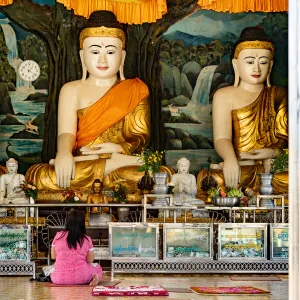
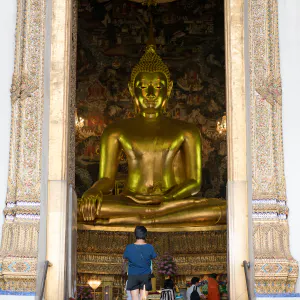
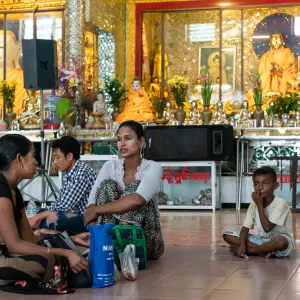
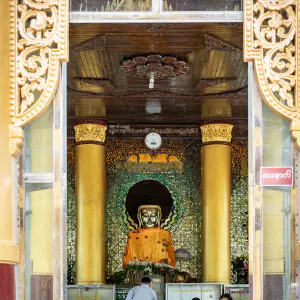
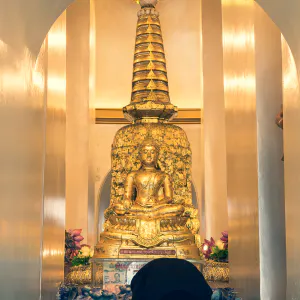
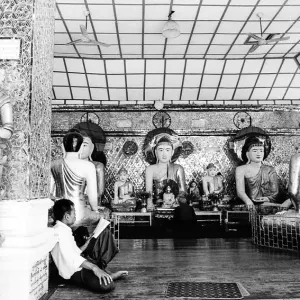
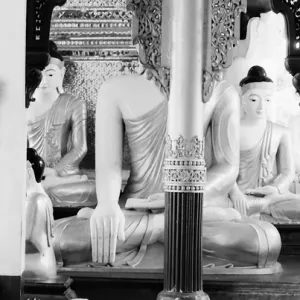
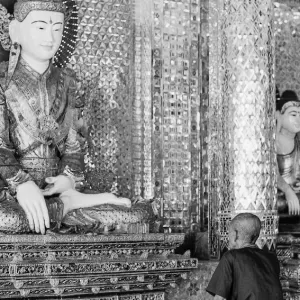
PHOTO DATA
No
4417
Shooting Date
Mar 2010
Posted On
August 4, 2010
Modified On
June 9, 2026
Place
Yangon, Myanmar
Genre
Candid Photography
Camera
CANON EOS 1V
Lens
EF24MM F1.4L USM