Even the Umayyad Mosque, one of the world's oldest, is merely a square in the eyes of children
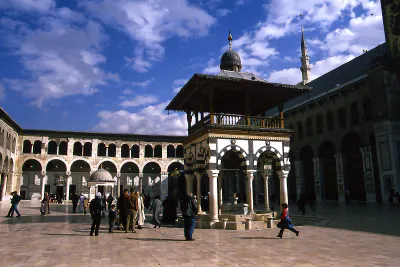
Standing in the courtyard of the Umayyad Mosque in Damascus, one is struck first by its sheer breadth. The polished stone floor catches the sunlight and throws it upward in a blinding shimmer, turning the entire square into a kind of luminous mirror. A few worshippers move quietly along the edges, but the true masters of the space are the children. They race across the courtyard with no regard for reverence, shrieking, chasing each other, falling, laughing. One of the oldest mosques in the world becomes, in their hands—or rather, under their feet—nothing more or less than a playground. The divide between the sacred and the ordinary is thinner than anyone likes to pretend.
That this majestic mosque once served as a Christian basilica still feels like a trick of history. Before it was a mosque, it was known as the Church of St. John the Baptist. And before that, the site held a Roman temple dedicated to Jupiter. Holy places seem to possess a kind of magnetic field: religions change, conquerors come and go, yet devotion continues to pool in the same corner of earth. Perhaps new rulers overwrite old faiths to claim legitimacy; perhaps humans simply return to the same stones in search of answers. Either way, belief has always been a highly territorial form of politics.
When Damascus came under Islamic rule in the 7th century, the church was transformed into a mosque. In the 9th century, a square minaret—modeled after the church tower that once stood here—was added. Its design eventually traveled westward, echoed across North Africa, until it became a hallmark of Moroccan skylines. Architecture, like religion, survives by copying, editing, and adapting itself to each new era.
| Oct 2005 ARCHITECTURE SYRIA | |
| COURTYARD DAMASCUS MOSQUE WORLD HERITAGE SITE |
Similar photos
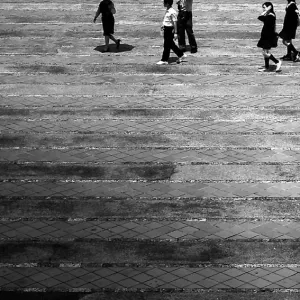






PHOTO DATA
No
207
Shooting Date
Feb 2001
Posted On
October 15, 2005
Modified On
December 4, 2025
Place
Damascus, Syria
Genre
Architectural Photography
Camera
CANON EOS KISS