People holding signs written in Hangul as they demonstrate in front of City Hall, where the Taegeukgi flag is flying
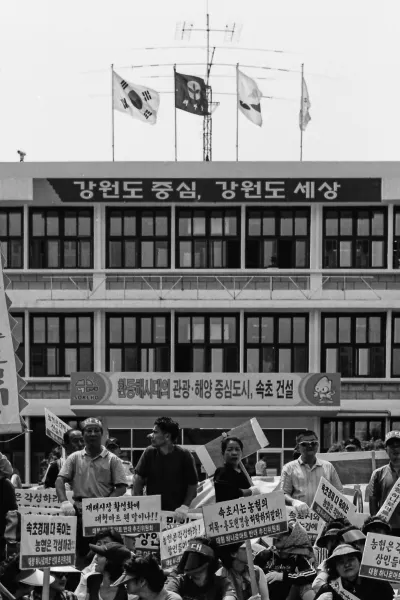
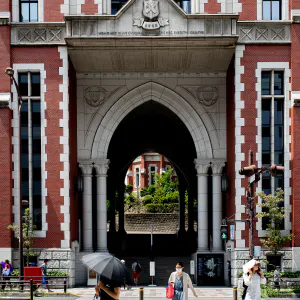
I was making my way north along South Korea’s eastern coast when I found myself wandering the streets of Sokcho. My aimless ambling eventually brought me to a halt before a grand, imposing building. Atop its roof, the Taegeukgi—the South Korean national flag—fluttered proudly in the breeze. I recalled hearing somewhere that the four black trigrams surrounding the central emblem represent the harmony of heaven, earth, fire, and water. Beneath this solemn banner, the building’s facade was emblazoned with a bold, sweeping slogan in Hangul. Even without a word of the language, the sheer gravity of the architecture and the prominence of the flag made one thing immediately clear: I was standing before the city hall.
What I could not fathom, however, was the commotion unfolding directly on its doorstep.
A dense crowd had gathered at the main entrance, their voices rising in a collective crescendo as they thrust rectangular placards into the air. I was witnessing a demonstration in full swing. South Korea is a nation fueled by a formidable public energy, a place where people readily take to the streets to give voice to their collective convictions. I stared intently at the placards, searching for a clue, but the geometric shapes of the Korean alphabet offered no answers. Invented by King Sejong the Great in the 15th century, Hangul is celebrated as a brilliantly rational phonetic system combining consonants and vowels. Yet, to an outsider like me, it remained an impenetrable wall of cryptograms.
Confronted by these undecipherable signs, I allowed my imagination to fill the silence. What, I wondered, had ignited such fierce indignation? Were they protesting an eyesore of a billboard defacing their city, or were they simply furious about the options on today's lunch menu?
To anyone fluent in Hangul, the cause would have been obvious at a single glance. But to a traveler marooned on the far side of a language barrier, even the rawest expressions of human anger can begin to look like a piece of absurd theater. It was a humbling reminder of how easily detachment can turn empathy into a spectator sport.
| Oct 2008 IN THE CITY SOUTH KOREA | |
| CITY HALL DEMONSTRATION PLACARD SOKCHO |
Similar photos



PHOTO DATA
No
2109
Shooting Date
Jun 2008
Posted On
October 16, 2008
Modified On
June 10, 2026
Place
Sokcho, South Korea
Genre
Street Photography
Camera
CANON EOS 1V
Lens
EF85MM F1.2L II USM