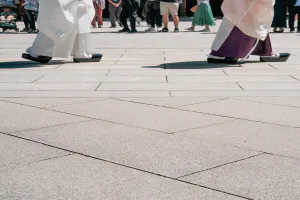
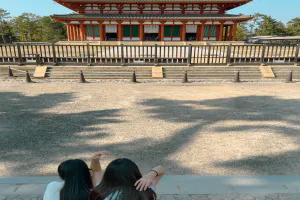
A girl in a knit cap walking in front of the main hall at Meiji Jingu while using her cell phone
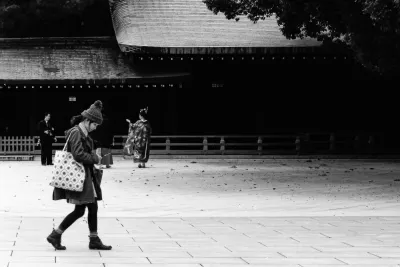
On a biting day in early winter, I walked through the sprawling, dense forest of Harajuku and stepped onto the wide grounds of Meiji Jingu Shrine. Established in 1920, this sanctuary lacks the multi-millennial lineage of Japan’s ancient Shinto shrines. Yet, it has already passed its centenary. One hundred years is more than enough time to completely reshape the human world. With a century gone by, it goes without saying that the appearance and attire of the pilgrims gathering here today bear absolutely no resemblance to those who walked these paths at its inception.
As if to perfectly personify this radical leap into modernity, a young girl shuffled past me. She wore a thick knit cap crowned with an oversized pom-pom, and her hand gripped a smartphone. Rather than moving with solemn reverence toward the main shrine, she walked with her head bowed, utterly absorbed in her screen. Granted, a century ago in Japan, knit caps—affectionately dubbed Shochan-bo—were actually a massive fashion trend, so the headwear at least holds a tenuous link to the past. But this miracle of modern civilization, a wafer-thin slab of metal sending radio waves to communicate with the entire globe? That would have been unimaginable, even if one stood on their head.
The deity enshrined here, Emperor Meiji, was well-known in his lifetime for his fondness for novelty, eagerly embracing Western technology. Yet, surely even he could never have predicted that within his own sacred grounds, people would spend every waking hour staring into tiny, glowing rectangles, guided blindly by their screens. Even for a god, keeping up with the dizzying pace of modern technological updates must be an exhausting task.
| Feb 2009 PEOPLE TOKYO | |
| CELL PHONE KNIT CAP MEIJI JINGU PRECINCT |
Similar photos






PHOTO DATA
No
2540
Shooting Date
Nov 2008
Posted On
February 26, 2009
Modified On
June 18, 2026
Place
Meiji Jingu, Tokyo
Genre
Street Photography
Camera
CANON EOS 1V
Lens
EF85MM F1.2L II USM