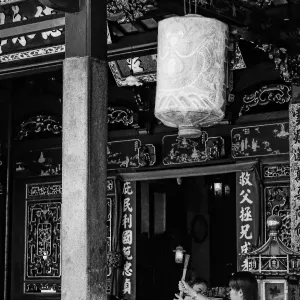
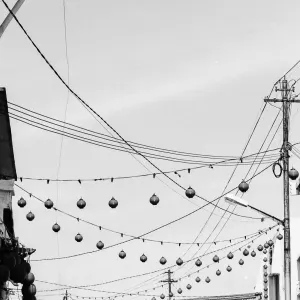
The bicycle was seen running the street through the gates of Cheng Hoon Teng
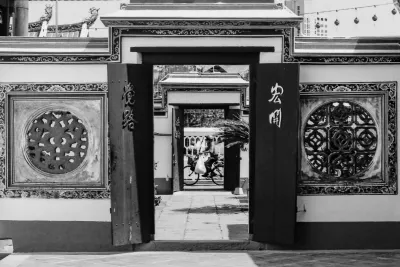
Wandering through the historic lanes of Malacca’s old town, I found myself stepping into the grounds of Cheng Hoon Teng, a venerable Chinese temple recognized as a UNESCO World Heritage site. Immediately, a wave of disorientation washed over me; the atmosphere was worlds apart from the serene shrines and temples of Japan. While cultural divergences are only natural, what struck me most was the absolute, unyielding pragmatism of the space. There were no elegant, contemplative gardens to speak of—only a dense succession of stark, functional altars. In Kyoto, renowned temples treat visitors to masterfully designed rock gardens meant to soothe the soul and please the eye. Here, however, the architecture is strictly dictated by the principles of Feng Shui. It is built not as a canvas for appreciating nature, but as a utilitarian ritual space designed solely for communicating with the divine. The luxury of slipping into a gentle melancholy while staring at raked white gravel is a concept entirely foreign to this layout.
In lieu of the leisurely romance of a garden, the courtyard was packed to the brim with an astonishing number of altars, leaving barely any breathing room. They were so numerous that I stood frozen, utterly at a loss as to which divine station I should approach to pay my respects. Within these walls, a diverse pantheon coexists—from Taoist deities and the Goddess of the Sea, Mazu, to the Bodhisattva Guanyin. Naturally, with such an array of distinct spirits, their spheres of influence must be highly specialized. I couldn't help but amuse myself with the thought of a celestial mix-up: what if a worshipper accidentally approached the wrong spiritual counter, asking for a booming business but walking away with nothing but a blessing for robust health? It would be a comical case of crossed wires. Yet, the local devotees seemed entirely untroubled by my shallow anxieties, dutifully and rhythmically making their rounds to every single altar with solemn reverence.
As I observed this steady flow of profound devotion, I retreated into the cool shadows of the main hall, letting my gaze drift out through the heavy, wide-open gates. Set against stark white walls, the dark wooden doors bore large characters painted in white: Hong Kai (宏開) and Jue Lu (覚路). They form a profound Buddhist reminder, urging passersby to "open the gates wide and embark on the path to enlightenment." Peering out through the nested layers of the doorways, I spotted a man pedaling a bicycle heavily laden with goods, cutting across the street outside. Framed precisely by the geometric lines of the ancient entrance, the fleeting everyday scene transformed instantly into a living painting—a quiet vignette of the mundane world captured from the threshold of the sacred.
| Apr 2009 IN THE CITY MALAYSIA | |
| BICYCLE CHINATOWN CHINESE CHARACTER GATE MALACCA TEMPLE |
Similar photos
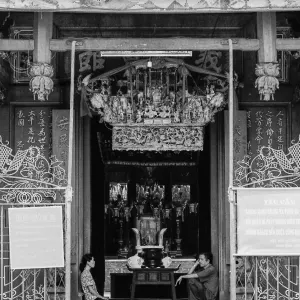
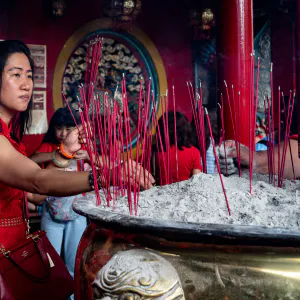
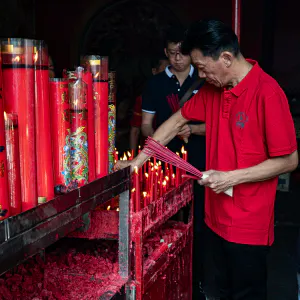


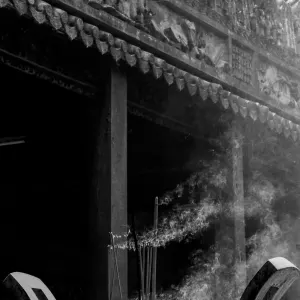

PHOTO DATA
No
2667
Shooting Date
Dec 2008
Posted On
April 8, 2009
Modified On
July 14, 2026
Place
Malacca, Malaysia
Genre
Street Photography
Camera
CANON EOS 1V
Lens
EF85MM F1.2L II USM