A boy lying on a tree that leans heavily over the edge of a pond, relaxing leisurely
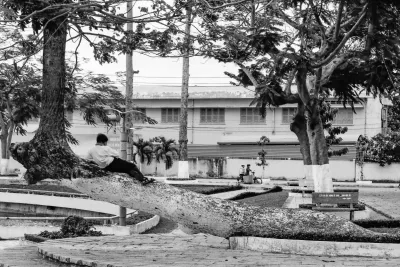
I was wandering through Bến Tre, a quiet enclave nestled in the green folds of the Mekong Delta in southern Vietnam. Even in this sleepy countryside, there are pockets of community life—like the banks of a tidy local pond where residents gather to catch a stray breeze. It was there that I spotted a large tree leaning at an angle so severe it seemed to defy physics. To say it was "standing" would be a generous lie; the tree had long since abandoned its struggle against gravity, choosing instead to languidly recline.
The local street trees here are kept in neat, orderly fashion, their lower trunks painted a stark, chalky white. It is an old, practical wisdom: coating the bark in slaked lime protects the trees from boring insects and fungal diseases, while also serving as a luminous guide for night-time travelers. Yet, among this disciplined row of trees—all standing at attention in their clean white trousers—this single, horizontal rebel cut a wonderfully eccentric figure.
Looking closer at this whitewashed, reclining trunk, I noticed a young boy perched upon its slope with incredible dexterity. He had settled into the perfect sweet spot of the incline, cradled by the living wood. He looked far more comfortable than anyone sitting on a standard park bench.
There is a subtle psychology to how we occupy space. If you sit on a bench, you are merely a passive observer—just "a person sitting down." But by conquering this crooked trunk and using its strange geometry to lounge, the boy’s posture became an active, defiant declaration of leisure. His body language practically broadcasted to the entire park: "Look at me. I am aggressively, unapologetically relaxing."
Perhaps this very act of self-persuasion—this stubborn mental insistence on one’s own comfort—is the ultimate secret to unwinding. In medicine, we are intimately familiar with the "placebo effect," where a patient's condition improves after taking a completely inert substance, simply because they believe it to be medicine. The term itself is beautiful, derived from the Latin placebo, meaning "I shall please."
If we apply this gentle trick of the mind to the boy on the tree, the physical reality of his seat ceases to matter. The bark might be rough, the angle awkward, and the wood unyielding against his spine. But because he has fully convinced himself that this tilted trunk is the most coveted VIP seat in Bến Tre, his brain accepts it as absolute truth. Comfort, it turns out, is not a matter of upholstery—it is a trick we play on our own minds to find peace wherever we happen to land.
| Jun 2009 PEOPLE VIETNAM | |
| BACK SHOT BEN TRE BOY RELAX TREE |
Similar photos








PHOTO DATA
No
2926
Shooting Date
Mar 2009
Posted On
June 27, 2009
Modified On
July 15, 2026
Place
Ben Tre, Vietnam
Genre
Candid Photography
Camera
CANON EOS 1V
Lens
EF85MM F1.2L II USM